
Introduction
The Cauchy-Riemann equations are a pair of partial differential equations that lie at the heart of complex analysis. They give a necessary condition for a complex function to be complex differentiable, and — together with a mild continuity assumption — a sufficient one. A function that is complex differentiable throughout an open set is called holomorphic on that set.
The point that makes complex differentiability special is this: it is a far stronger requirement than differentiability of the same function viewed as a map from  to . The Cauchy-Riemann equations are precisely the extra constraint that captures this difference.
Complex Functions and Differentiability
A complex function is a function whose domain and range both exist within the set of complex numbers. We can always split such a function into its real and imaginary parts,  , where
  and
and  and
and  are real-valued functions of the two real variables
  and
and  .
.
A complex function  is said to be differentiable at a point
  in its domain if the limit

exists. The crucial subtlety is hidden in the words “ “: in the complex plane,
  can approach
  from any direction, and the value of the limit must be the same for all of them. On the real line there are only two directions to worry about (from the left and from the right); in the complex plane there are infinitely many. Demanding a single common limiting value is a strong constraint, and it is exactly this constraint that produces the Cauchy-Riemann equations.
Deriving the Equations
Suppose  exists. Because the limit must be independent of direction, we are free to compute it along any path we like, and the answers must agree. Comparing two convenient choices is enough.
Approach along the real axis. Take  real. Then

Approach along the imaginary axis. Take  . Using
  ,
,

Since these two expressions for must be equal, we match real part with real part and imaginary part with imaginary part. That gives exactly the Cauchy-Riemann equations.
The Cauchy-Riemann Equations
The Cauchy-Riemann equations are given by:


When they hold, the derivative itself can be written compactly as

Necessary, but Not Quite Sufficient
The derivation shows that the Cauchy-Riemann equations are necessary: any function that is complex differentiable at a point must satisfy them there. The converse needs care. Satisfying the equations at a single point is not by itself enough to guarantee differentiability there.
A standard counterexample is  , so that
  and
and  . At the origin all four first-order partial derivatives vanish, so the Cauchy-Riemann equations are satisfied. Yet the difference quotient approaches along the coordinate axes while approaching a nonzero value along the line
  , so
, so  does not exist.
The clean statement is a sufficiency theorem: if  and
and  have continuous first-order partial derivatives in a neighborhood of and satisfy the Cauchy-Riemann equations there, then
  is complex differentiable at . Continuity of the partial derivatives is what upgrades the equations from necessary to sufficient.
Worked Examples
A holomorphic function. Let  . Expanding,
  , so
, so  and
and  . Then

Both equations hold everywhere, and the formula above gives  , exactly as expected.
A function that fails. Let  , so
, so  and
and  . Here
  but
but  . The first Cauchy-Riemann equation fails at every point, so complex conjugation is nowhere complex differentiable — even though, as a map
  , it is perfectly smooth. This is a vivid illustration of how much stronger complex differentiability is than real differentiability.
Geometric Meaning
Viewing as a map from to , its derivative is the Jacobian matrix
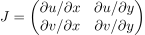
The Cauchy-Riemann equations force this matrix into the special form

This is exactly the matrix that represents multiplication by the complex number  : a rotation by
  together with a scaling by
  . So wherever
  , a holomorphic function acts locally like a rotation followed by a uniform scaling. Because rotations and uniform scalings preserve angles, holomorphic functions are conformal — and this is the “deep symmetry” that makes complex analysis so rigid and so powerful.
Harmonic Functions
Holomorphic functions are infinitely differentiable (itself a nontrivial result of complex analysis), so we may differentiate the Cauchy-Riemann equations freely. Differentiating with respect to , and with respect to , then adding the results:

where the right-hand side vanishes because the mixed partial derivatives are equal. Thus satisfies Laplace’s equation
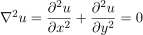
and the identical argument applies to . A twice continuously differentiable solution of Laplace’s equation is called a harmonic function, so the real and imaginary parts of a holomorphic function are always harmonic. They are not independent, however: and remain tied together by the Cauchy-Riemann equations, and for this reason is called a harmonic conjugate of .
Applications of the Cauchy-Riemann Equations
The link between holomorphic functions and harmonic functions makes the Cauchy-Riemann equations a practical tool in two-dimensional physics. In ideal fluid flow and in electrostatics, one packages a potential  and a stream function
  into a single holomorphic complex potential
  . The Cauchy-Riemann equations then guarantee both that and are harmonic and that their level curves — equipotential lines and streamlines — intersect at right angles, a direct consequence of conformality.
Conformality also underlies the method of conformal mapping, in which a holomorphic function transports a hard-to-handle domain to a simple one (such as a disk or a half-plane) while preserving angles. A boundary-value problem for Laplace’s equation can be solved in the simple domain and then mapped back to the original. The same circle of ideas supports analytic continuation, the extension of a holomorphic function beyond its original domain of definition.
Conclusion
The Cauchy-Riemann equations express, in two short identities, what it means for a complex function to have a derivative that does not depend on direction. From that single requirement flow the rigidity of holomorphic functions, their conformality, and the harmonicity of their real and imaginary parts. Seeing where the equations come from — and where they fall short — turns them from a formula to be memorized into a lens for understanding the structure of the complex plane.
Do you prefer video lectures over reading a webpage? Follow us on YouTube to stay updated with the latest video content!
Want to study more? Visit our Index here!
Leave a Reply